Representatives from Government and CSOs Meet, Discuss on Open Government Partnership (OGP)
by Sin Putheary, Head of Communications and Membership Development
Phnom Penh (October 16-17, 2014) – Around 150 senior representatives from Indonesia, the Philippines, Vietnam, and as well as Cambodia are attending the two-day workshop on Open Government Partnership which focuses on the following objectives:
- to disseminate OGP’s values, mechanisms, goals and communities to the governments and CSO communities;
- to disseminate the benefits from transparency, participation and accountability that the countries would gain by joining OGP;
- to expose the governments to the partnership between the government and civil society as the underlying character of OGP;
- to shine a particular spotlight on certain transparency, participation and accountability reforms that have been carried out that have the potential to help the countries pass OGP eligibility standard; and
- to develop a map of reformers and the fulfillment of OGP eligibility standard for the respective five countries and project dates to join OGP.
Background of OGP
Open Government Partnership is an important indicator of support from the government and civil society around the world. OGP’s overriding objective is to make sure that real change is happening on the ground in a majority of OGP countries and that this change is benefiting citizens. OGP commitments have been grouped into seven clusters according to the intended results of the reform.
- Public Participation: Engage Citizens in Policy Making.
- Government Integrity: Fighting Corruption and Strengthening Democratic institutions.
- Freedom of Information_ Guaranteeing Public Access to Government Information
- Fiscal Transparency_ Helping Citizens Follow the Money.
- Public Service Delivery_ Making services Work for the People.
- Extractive Resources Transparency_ Ensuring Extract Revenues are used for Public Benefit.
- Open Data_ Digitizing and Opening up Government Data for Access to information and Transparency.
Countries with New National Action Plans: Albania, Armenia, Brazil, Bulgaria, Chile, Croatia, Denmark, Dominican Rep, El Salvador, Estonia, Georgia, Greece, Guatemala, Honduras, Indonesia, Ireland, Lithuania, Macedonia, Mexico, Moldova, Mongolia, Norway, Paraguay, the Philippines, Romania, Sierra Leone, South Africa, South Korea, Spain, Sweden, Tanzania, United Kingdom, United States, Uruguay.
Quotation
H.E. Dr. Om Yentieng, President of Anti-Corruption Unit (ACU) welcomes OGP concept and appreciates the commitment of CSOs and organizers for making this global moment happens within Cambodian context.
“I would like to welcome the partnership between the Civil Society and the government. We open the door for the development,” said H.E. Dr. Om Yentieng.
For more documents and photos of this workshop, please follow THIS LINK
Other Latest News
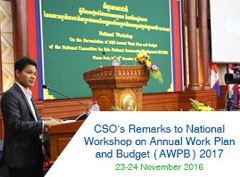
CSO’s Remarks to National Workshop on Annual Work Plan and Budget (AWPB) 2017 of NSDD
The decentralization reform is about promoting local democratic development and the people demand centered responses. It needs a multi-stakeholder approach and environment that enable all actors (state and non-state) including women and youth to play their necessary balance and complementary roles in this important reform process.
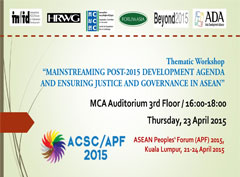
Two main thematic issues will be brought to ASEAN People's Forum
Cooperation Committee for Cambodia (CCC) will bring the concerns over two main thematic issues to ASEAN Peoples’ Forum (APF) 2015_ Kuala Lumpur 21-24 April 2015.
Statement of the International Conference on the 25th Anniversary of the 1991 Paris Peace Accords on Cambodia
We, the participants in the International Conference on the 25th Anniversary of the 1991 Paris Peace Accords on Cambodia (“the Paris Peace Agreements”), recall the importance of the obligations contained in the 1991 Paris Peace Agreements, which brought an end to decades of conflict and civil war in Cambodia, and laid the framework for a prosperous and peaceful future, based on human rights, participatory democracy, and the rule of law.
NGO Code, Voluntary Certification System for CSOs in Cambodia to be Revised
Phnom Penh (August 5, 2014) – Dr Sok Thim, Chairperson of Executive Committee of Cooperation Committee for Cambodia (CCC), called for support and active participants from CCC’s 147 members to promote the application of the Code of Ethical Principles and Minimum Standards for NGOs in Cambodia and Voluntary Certification System (VCS).
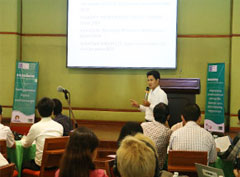
CSO Leaders Meeting“Roadmap and Post LANGO Consultation”
Phnom Penh - 28 August 2015 : Around 60 participants from the leaders and senior management team of civil society organizations, associations, unions and development partners to participate in the consultation....
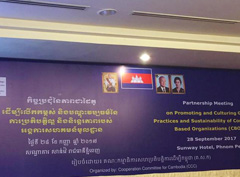
Partnership Meeting on Promoting and Culturing Good Practices and Sustainability of Community-Based Organizations (CBOs)
On 28 September 2017 The Cooperation Committee for Cambodia (CCC) organized Partnership Meeting on Promoting and Culturing Good Practices and Sustainability of CBOs.
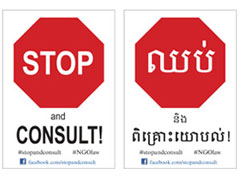
The fourth draft includes concerning threats to freedoms of association and the ability of civil society organizations to support Cambodians.
The fourth draft includes concerning threats to freedoms of association and the ability of civil society organizations to support Cambodians. .
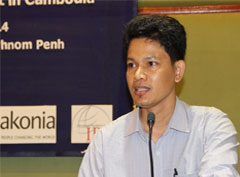
Recently-passed, draft laws discussed among CSOs
Phnom Penh (July 09, 2014) – Around 200 representatives from NGOs, Associations, Community Based Organizations (CBOs), NGO Provincial Networks, and Informal Groups met in a full-day dialogue to discuss and share their concerns, analysis, and advocacy plans on draft laws and passed laws with important implications for civil society at the Korean Society for Service in Asia (KSSA), Phnom Penh.